
Research
The Barbour lab focuses on uncovering the multi-scale mechanisms by which altered neuronal circuitry disrupts memory in Alzheimer's disease.

Brain-wide network activity.
We employ brain-wide mapping of memory networks to define aberrant activity patterns and hub regions that emerge in prodromal AD. By combining advanced imaging with computational network analyses, we aim to uncover how coordinated recall dynamics are altered in prodromal Alzheimer's disease.

in vivo circuit interrogation.
Using calcium imaging and optogenetic manipulation in freely behaving mice, we can link circuit activity to memory function in prodromal Alzheimer's disease models. These experiments will establish causal links between population activity and memory outcomes, thus identifying the neuronal circuitry as a target to restore memory.
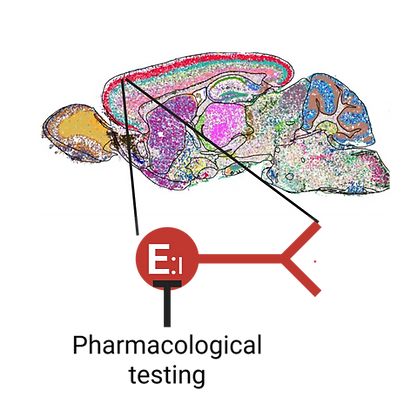
Identification and targeting of molecular pathways underlying aberrant neuronal activity to restore memory.
We will apply molecular profiling through spatial transcriptomics to uncover the cellular mechanisms causing aberrant activity in the neuronal populations and networks that underlie memory dysfunction. Our goal is to link molecular alterations to brain-wide network dysfunction and identify targets to restore recall circuitry in prodromal AD.